

-
1 electrical starter
program starter — пускатель программы; стартер
English-Russian big polytechnic dictionary > electrical starter
-
2 starter
стартёр; пусковой прибор; пускатель; короткий бур; забурник; диспетчер- starter battery - starter button - starter cable - starter carburetor - starter control - starter dog - starter-generator - starter ground strap - starter motor - starter mounting - starter pawl - starter pedal - starter push - starter ring gear - starter strap - starter switch - starter with internal reduction gear - air starter - air-cooled starter - air-turbine starter - automatic starter - automatic motor starter - centrifugal starter - coincidental starter - combustion turbine starter - compensator starter - compressed-air starter - constant-time starter - electrical inertia starter - oil starter - push-on starter - rheostatic starter - series-parallel starter - spring-type self-starter - stator starter - switch starter - three-point starter -
3 motor
1) двигатель, проф. мотор3) автомобиль•-
abutment motor
-
ac converter-fed motor
-
ac electronic motor
-
ac motor
-
across-the-line motor
-
actuating motor
-
acyclic motor
-
adjustable varying-speed motor
- adjustable-constant speed motor -
adjustable-speed motor
-
air motor
-
all-watt motor
-
appliance motor
-
arch induction motor
-
armature-controlled motor
-
asynchronous motor
-
autosyn motor
-
autosynchronous motor
-
auxiliary motor
-
axial piston motor
-
axial-piston air motor
-
axle-hung motor
-
azimuth torque motor
-
barring motor
-
bipolar motor
-
booster motor
-
boost motor
-
brake motor
-
brushless dc linear motor
-
brushless motor
-
built-in motor
-
cage motor
-
capacitor motor
-
capacitor-start motor
-
capacitor-start-and-capacitor-run motor
-
changeable-pole motor
-
change-pole motor
-
change-speed motor
-
commutator motor
-
commutatorless motor
-
compensated induction motor
-
compensated motor
-
compensated linear induction motor
-
compound-wound motor
-
compound motor
-
concatenated motor
-
condenser motor
-
constant displacement motor
-
constant-current motor
-
constant-speed motor
-
constant-voltage motor
-
control motor
-
crane motor
-
cranking motor
-
crowd motor
-
crystal-controlled motor
-
current-displacement motor
-
cylindrical-rotor motor
-
dc electronic motor
-
dc motor
-
dc torque motor
-
deep bar motor
-
differential motor
-
digital motor
-
double-armature motor
-
double-commutator motor
-
double-deck induction motor
-
double-side linear motor
-
double-speed motor
-
double-squirrel cage motor
-
doubly-fed motor
-
downhole motor
-
drag-cup induction motor
-
drag-cup motor
-
dripproof motor
-
drive motor
-
driving motor
-
drooping speed motor
-
drum-wound motor
-
dual-voltage motor
-
dustproof motor
-
efficient motor
-
electric controlling motor
-
electric downhole motor
-
electric motor
-
electric starting motor
-
electrohydraulic pulse motor
-
electronically commutated brush-less dc motor
-
electrostatic motor
-
enclosed fan-cooled motor
-
enclosed self-cooled motor
-
enclosed self-ventilated motor
-
enclosed separately ventilated motor
-
enclosed-type motor
-
energy efficient motor
-
energy saver motor
-
erection torque motor
-
explosion-proof motor
-
fan-duty motor
-
fan motor
-
feathering motor
-
feed motor
-
flange-mounted motor
-
flange motor
-
floor-mounted motor
-
floor motor
-
follow-up motor
-
forced-ventilation motor
-
fractional horsepower motor
-
fully enclosed motor
-
gear hydraulic motor
-
geared motor
-
gear motor
-
geared starter motor
-
gearless motor
-
general-purpose motor
-
handgrip motor
-
high-phase order induction motor
-
high-slip induction motor
-
high-slip motor
-
high-speed motor
-
high-voltage motor
-
home-going motor
-
hydraulic downhole motor
-
hydraulic motor
-
hydraulic step motor
-
hydraulic turbine downhole motor
-
hydraulic wheel motor
-
hysteresis synchronous motor
-
hysteresis-reluctance motor
-
induction motor
-
inductor motor
-
integrated motor
-
interpole motor
-
leveling torque motor
-
linear induction motor
-
linear motor
-
linear pulse motor
-
linear reluctance motor
-
linear synchronous motor
-
line-fed motor
-
line-start motor
-
load-start motor
-
low-inertia high-torque motor
-
machine-tool motor
-
main motor
-
mine motor
-
mud motor
-
multiple-winding motor
-
multipolar motor
-
multipole motor
-
multispeed motor
-
navy motor
-
needle positioning clutch motor
-
nonreversible motor
-
nonsalient pole motor
-
one-cylinder motor
-
open motor
-
open-loop stepping motor
-
outboard motor
-
outdoor motor
-
permanent-magnet motor
-
phase-wound rotor motor
-
photovoltaic motor
-
pilot motor
-
piston hydraulic motor
-
pitch erection torque motor
-
PM motor
-
point motor
-
pole-changing motor
-
polyphase motor
-
pony motor
-
power plant motor
-
printed-circuit motor
-
programmable drive motor
-
propel motor
-
propulsion motor
-
quiet low rpm induction motor
-
railway motor
-
reactor-start motor
-
reactor-start split-phase motor
-
reciprocating motor
-
reduction motor
-
reluctance motor
-
reluctance-augmented shaded-pole motor
-
repulsion motor
-
repulsion-start induction-run motor
-
repulsion-start induction motor
-
resiliently mounted traction motor
-
resistance-start motor
-
reversible hydraulic motor
-
reversible motor
-
reversing motor
-
roll erection torque motor
-
rotary-field motor
-
rotating case axial piston motor
-
rotating induction motor
-
round-rotor motor
-
screw hydraulic downhole motor
-
screw downhole motor
-
sectional downhole motor
-
self-controlled inverter-fed synchronous motor
-
self-controlled synchronous motor
-
self-excited motor
-
self-starting motor
-
self-ventilated motor
-
selsyn motor
-
semienclosed motor
-
semiclosed motor
-
separately excited motor
-
series-wound motor
-
series motor
-
servo motor
-
shaded-pole motor
-
shaftless motor
-
shell-type motor
-
shielded pole motor
-
short motor
-
shunt-wound motor
-
shunt motor
-
single-frame motor
-
single-phase motor
-
single-side linear motor
-
slave motor
-
slaving torque motor
-
slip-ring induction motor
-
slip-ring motor
-
special-purpose motor
-
splash-proof motor
-
split-field motor
-
split-phase motor
-
split-pole motor
-
squirrel-cage induction motor
-
squirrel-cage motor
-
starter motor
-
starting motor
-
steering electric motor
-
step-by-step motor
-
step motor
-
stepper motor
-
stepping motor
-
subfractional horsepower electrical motor
-
submersible motor
-
superconducting motor
-
switch motor
-
synchro motor
-
synchronous motor
-
take-home motor
-
tap-field motor
-
three-phase motor
-
throttle servo motor
-
thyratron motor
-
thyristor-controlled motor
-
thyristor motor
-
torque motor
-
totally enclosed motor
-
toy motor
-
traction motor
-
turbine air motor
-
turbine motor
-
two direction hydraulic motor
-
two-phase motor
-
two-pole motor
-
two-speed motor
-
two-value capacitor motor
-
undulated-current motor
-
universal motor
-
unlaminated-rotor induction motor
-
vacuum motor
-
variable displacement hydraulic motor
-
variable speed dc motor
-
variable-speed motor
-
varying-speed motor
-
ventilated motor
-
vertical shaft motor
-
volumetric downhole motor
-
watertight motor
-
winding-duty motor
-
winding motor
-
wound-rotor induction motor -
4 motor starter
-
5 reactance starter
English-Russian big polytechnic dictionary > reactance starter
-
6 rheostatic starter
English-Russian big polytechnic dictionary > rheostatic starter
-
7 push-on starter
program starter — пускатель программы; стартер
English-Russian big polytechnic dictionary > push-on starter
-
8 autotransformer starter
English-Russian big medical dictionary > autotransformer starter
-
9 full voltage starter application
прямой пуск вращающегося электродвигателя
Пуск вращающегося электродвигателя путем непосредственного подключения его к питающей сети.
[ ГОСТ 27471-87]EN
direct-on-line starting
across-the-line starting (US)
the process of starting a motor by connecting it directly to the supply at rated voltage
[IEV number 411-52-15]FR
démarrage direct
mode de démarrage d'un moteur, consistant à lui appliquer directement sa pleine tension assignée
[IEV number 411-52-15]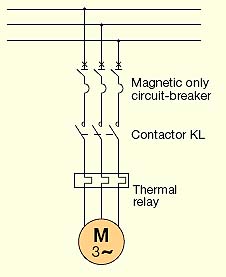
Рис. ABB
Схема прямого пуска электродвигателяMagnetic only circuit-breaker - Автоматический выключатель с электромагнитным расцепителем
Contactor KL - Контактор KL
Thermal relay - Тепловое реле
Параллельные тексты EN-RU
Direct-on-line starting
Direct-on-line starting, which is often abbreviated as DOL, is perhaps the most traditional system and consists in connecting the motor directly to the supply network, thus carrying out starting at full voltage.Direct-on-line starting represents the simplest and the most economical system to start a squirrel-cage asynchronous motor and it is the most used.
As represented in Figure 5, it provides the direct connection to the supply network and therefore starting is carried out at full voltage and with constant frequency, developing a high starting torque with very reduced acceleration times.
The typical applications are relevant to small power motors also with full load starting.
These advantages are linked to some problems such as, for example, the high inrush current, which - in the first instants - can reach values of about 10 to 12 times the rated current, then can decrease to about 6 to 8 times the rated current and can persist to reach the maximum torque speed.The effects of such currents can be identified with the high electro-dynamical stresses on the motor connection cables and could affect also the windings of the motor itself; besides, the high inrush torques can cause violent accelerations which stress the transmission components (belts and joints) generating distribution problems with a reduction in the mechanical life of these elements.
Finally, also the possible electrical problems due to voltage drops on the supply line of the motor or of the connected equipment must be taken into consideration.
[ABB]Прямой пуск
Прямой пуск, который по-английски часто сокращенно обозначают как DOL, является, пожалуй наиболее распространенным способом пуска. Он заключается в непосредственном (т. е. прямом) подключении двигателя к питающей сети. Это означает, что пуск двигателя осуществляется при полном напряжении.Схема прямого пуска является наиболее простым, экономичным и чаще всего применяемым решением для электродвигателей с короткозамкнутым ротором.
Схема прямого подключения к сети представлена на рисунке 5. Пуск осуществляется при полном напряжении и постоянной частоте сети. Электродвигатель развивает высокий пусковой момент при коротком времени разгона.
Типичные области применения – маломощные электродвигатели, в том числе с пуском при полной нагрузке.
Однако, наряду с преимуществами имеются и определенные недостатки, например, бросок пускового тока, достигающий в первоначальный момент 10…12-кратного значения от номинального тока электродвигателя. Затем ток двигателя уменьшается примерно до 6…8-кратного значения номинального тока и будет держаться на этом уровне до тех пор, пока скорость двигателя не достигнет максимального значения.
Такое изменение тока оказывает значительное электродинамическое воздействие на кабель, подключенный к двигателю. Кроме того пусковой ток воздействует на обмотки двигателя. Высокий начальный пусковой момент может привести к значительному ускорению и следовательно к значительной нагрузке элементов привода (ремней, крепления узлов), что вызывает сокращение их срока службы.
И, наконец, следует принять во внимание возможное возникновение проблем, связанных с падением напряжения в линии питания двигателя и подключенного к этой линии оборудования.
[Перевод Интент]
Тематики
Синонимы
EN
- across-the-line starting (US)
- direct line starting
- direct operation of a motor
- direct starting
- direct-on-line starting
- DOL
- full voltage starter application
DE
FR
Англо-русский словарь нормативно-технической терминологии > full voltage starter application
-
10 direct operation of a motor
прямой пуск вращающегося электродвигателя
Пуск вращающегося электродвигателя путем непосредственного подключения его к питающей сети.
[ ГОСТ 27471-87]EN
direct-on-line starting
across-the-line starting (US)
the process of starting a motor by connecting it directly to the supply at rated voltage
[IEV number 411-52-15]FR
démarrage direct
mode de démarrage d'un moteur, consistant à lui appliquer directement sa pleine tension assignée
[IEV number 411-52-15]
Рис. ABB
Схема прямого пуска электродвигателяMagnetic only circuit-breaker - Автоматический выключатель с электромагнитным расцепителем
Contactor KL - Контактор KL
Thermal relay - Тепловое реле
Параллельные тексты EN-RU
Direct-on-line starting
Direct-on-line starting, which is often abbreviated as DOL, is perhaps the most traditional system and consists in connecting the motor directly to the supply network, thus carrying out starting at full voltage.Direct-on-line starting represents the simplest and the most economical system to start a squirrel-cage asynchronous motor and it is the most used.
As represented in Figure 5, it provides the direct connection to the supply network and therefore starting is carried out at full voltage and with constant frequency, developing a high starting torque with very reduced acceleration times.
The typical applications are relevant to small power motors also with full load starting.
These advantages are linked to some problems such as, for example, the high inrush current, which - in the first instants - can reach values of about 10 to 12 times the rated current, then can decrease to about 6 to 8 times the rated current and can persist to reach the maximum torque speed.The effects of such currents can be identified with the high electro-dynamical stresses on the motor connection cables and could affect also the windings of the motor itself; besides, the high inrush torques can cause violent accelerations which stress the transmission components (belts and joints) generating distribution problems with a reduction in the mechanical life of these elements.
Finally, also the possible electrical problems due to voltage drops on the supply line of the motor or of the connected equipment must be taken into consideration.
[ABB]Прямой пуск
Прямой пуск, который по-английски часто сокращенно обозначают как DOL, является, пожалуй наиболее распространенным способом пуска. Он заключается в непосредственном (т. е. прямом) подключении двигателя к питающей сети. Это означает, что пуск двигателя осуществляется при полном напряжении.Схема прямого пуска является наиболее простым, экономичным и чаще всего применяемым решением для электродвигателей с короткозамкнутым ротором.
Схема прямого подключения к сети представлена на рисунке 5. Пуск осуществляется при полном напряжении и постоянной частоте сети. Электродвигатель развивает высокий пусковой момент при коротком времени разгона.
Типичные области применения – маломощные электродвигатели, в том числе с пуском при полной нагрузке.
Однако, наряду с преимуществами имеются и определенные недостатки, например, бросок пускового тока, достигающий в первоначальный момент 10…12-кратного значения от номинального тока электродвигателя. Затем ток двигателя уменьшается примерно до 6…8-кратного значения номинального тока и будет держаться на этом уровне до тех пор, пока скорость двигателя не достигнет максимального значения.
Такое изменение тока оказывает значительное электродинамическое воздействие на кабель, подключенный к двигателю. Кроме того пусковой ток воздействует на обмотки двигателя. Высокий начальный пусковой момент может привести к значительному ускорению и следовательно к значительной нагрузке элементов привода (ремней, крепления узлов), что вызывает сокращение их срока службы.
И, наконец, следует принять во внимание возможное возникновение проблем, связанных с падением напряжения в линии питания двигателя и подключенного к этой линии оборудования.
[Перевод Интент]
Тематики
Синонимы
EN
- across-the-line starting (US)
- direct line starting
- direct operation of a motor
- direct starting
- direct-on-line starting
- DOL
- full voltage starter application
DE
FR
Англо-русский словарь нормативно-технической терминологии > direct operation of a motor
-
11 drive
1) привод2) передача3) приведение в движение || приводить в движение4) забивать, вбивать, вколачивать5) управление ( автомобилем или поездом) || вести, управлять6) органы управления ( автомобиля)7) лесн. сплав сплавлять8) строить (дорогу, шоссе)9) горизонтальная горная выработка; туннель ||проходить горную выработку, туннель10) ход ( доменной печи)11) амер. улица; проезд; англ. подъездной путь12) вытеснение (напр. нефти из коллектора)13) режим ( в коллекторе нефти) при разработке14) эл. возбуждение; запуск || возбуждать; запускать16) ЗУ на магнитной ленте, накопитель на магнитной ленте, ММЛ17) вчт. дисковод•to drive down — 1. уменьшать число оборотов 2. забивать;to drive home — забивать до отказа;to drive off — отгонять, отделять;to drive out — 1. выделять ( путём нагрева растворённый газ) 2. подавлять ( генерацию);to drive up — увеличивать число оборотов; ускорять движение-
accessory drive
-
accumulator drive
-
adjustable fan drive
-
adjustable speed drive
-
adjustable speed hydraulic drive
-
advance unit drive
-
aerial drive
-
aileron drive
-
air drive
-
air-powered drive
-
all-wheel drive
-
alternating-current drive
-
amplidyne drive
-
ancillary drive
-
angle drive
-
antenna drive
-
artificial drive
-
asynchronous drive
-
automatic electric drive
-
auxiliary drive
-
axle drive
-
back drive
-
ball screw drive
-
battery drive
-
battery traction drive
-
belt drive
-
Bendix drive
-
bevel gear drive
-
bottom-water drive
-
cam drive
-
camera drive
-
camshaft drive
-
capstan drive
-
capstan tape drive
-
carbonated water drive
-
cartridge tape drive
-
center shift drive
-
chain drive
-
closed fluid power drive
-
close fluid power drive
-
combustion drive
-
common drive
-
compound mechanical drive
-
condensing-gas drive
-
configurable drive
-
continuous steam drive
-
continuously variable-ratio drive
-
controlled-velocity electric drive
-
conveyor drive
-
coordinate drive
-
cushioned drive
-
cushion drive
-
cyclic carbon dioxide drive
-
cycloid drive
-
depletion drive
-
diesel-electric drive
-
differential drive
-
direct drive
-
direct-current drive
-
direct-motor drive
-
disk drive
-
dissolved gas drive
-
double-chain drive
-
double-reduction final drive
-
double-speed drive
-
drum drive
-
dual drive
-
edge water drive
-
elastic water drive
-
elastic water gravity drive
-
elastic yarn drive
-
electric drive
-
electrical wheel-motor drive
-
electronically controlled drive
-
engine output drive
-
enriched gas drive
-
exhaust gas drive
-
exhaust-gas power drive
-
feeder drive
-
field drive
-
film drive
-
final drive
-
fixed fluid power drive
-
flexibility drive
-
fluid drive
-
fluid power drive
-
foam drive
-
follower drive
-
follow-up drive
-
foot drive
-
forward drive
-
four-wheel drive
-
frequency controlled electric drive
-
friction drive
-
front-end drive
-
front drive
-
frontal drive
-
frontal water drive
-
fully-automatic electric drive
-
furnace drive
-
gas cap drive
-
gas drive
-
gas-electric drive
-
gasoline-electric drive
-
gas-tube drive
-
gear drive
-
gearless drive
-
gearless electric drive
-
generator drive
-
Geneva drive
-
gravity drive
-
group electric drive
-
hand drive
-
hard drive
-
harmonic gear drive
-
harmonic drive
-
high drive
-
high-speed gear drive
-
horizontal drive
-
hot water drive
-
hydraulic drive
-
hydraulic pump drive
-
hydroelectric drive
-
hydrostatic drive
-
independent drive
-
individual drive
-
individual electric drive
-
induction motor drive
-
inert gas drive
-
in-line final drive
-
input drive
-
integral fluid drive
-
intermediate drive
-
intermittent drive
-
intermittent mechanism drive
-
internal gas drive
-
inverter drive
-
ladle-lift drive
-
leaning wheel drive
-
left-side drive
-
limited rotary fluid power drive
-
line drive
-
linear drive
-
linear fluid power drive
-
linear-motor slide drive
-
liquid clutch drive
-
machine axis drive
-
magnetic drive
-
magnetic-tape drive
-
magneto drive
-
magnetohydrodynamic drive
-
main drive
-
maltese cross drive
-
manual drive
-
master drive
-
mechanical drive
-
mold drive
-
motor drive
-
motorized drive
-
multibelt drive
-
multimotor drive
-
natural drive
-
negative drive
-
oil-electric drive
-
open fluid power drive
-
output turning drive
-
overhead drive
-
pattern drive
-
pedal drive
-
phase-locked drive
-
pinion drive
-
piston drive
-
planetary drive
-
planetary final drive
-
pneumatic drive
-
point lock drive
-
positive drive
-
power consumption drive
-
power drive
-
press drive
-
pulley drive
-
rack-and-gear drive
-
radial drive
-
ram drive
-
rapid-return drive
-
rear axle drive
-
rear wheel drive
-
rectifier controlled drive
-
rectifier drive
-
reduction electric drive
-
remote drive
-
return stroke drive
-
reversible drive
-
reversible electric drive
-
reversible hydraulic drive
-
reversing drive
-
right-side drive
-
rolling ring drive
-
rolling screw-motion drive
-
rotary fluid power drive
-
rotary tool drive
-
rotational electric drive
-
sectional belt drive
-
separate drive
-
servo drive
-
servocontrolled drive
-
shutter drive
-
single motorized drive
-
single-side drive
-
slave drive
-
slip-free drive
-
slot-and-crank drive
-
solenoid drive
-
solution gas drive
-
splitter drive
-
spring drive
-
sprocket drive
-
sprocket-tandem drive
-
starter-motor drive
-
steam drive
-
steam turbine drive
-
step electric drive
-
straight drive
-
streaming-tape drive
-
swing drive
-
synchronous drive
-
takeup drive
-
tandem drive
-
tape drive
-
temperature controlled fan drive
-
thyristor-motor drive
-
thyristor drive
-
timing drive
-
toothed belt drive
-
torque converter drive
-
torque limiting fan drive
-
tuning-fork drive
-
turbine drive
-
turbo electric drive
-
unidirectional hydraulic drive
-
unit drive
-
universal-joint drive
-
valve electric drive
-
variable fluid power drive
-
variable group drive
-
variable-frequency electric drive
-
variable-speed drive
-
variable-speed work drive
-
V-belt drive
-
vernier drive
-
vertical drive
-
vibratory electric drive
-
voltage drive
-
Ward-Leonard drive
-
water drive
-
water-gravity drive
-
windup drive
-
withdrawal-roll drive
-
workhead drive -
12 DOL
- эффект операционного рычага
- пускатель прямого действия
- прямой пуск вращающегося электродвигателя
- Министерство труда (США)
- концентрация растворённого кислорода
концентрация растворённого кислорода
—
[А.С.Гольдберг. Англо-русский энергетический словарь. 2006 г.]Тематики
EN
Министерство труда (США)
—
[А.С.Гольдберг. Англо-русский энергетический словарь. 2006 г.]Тематики
EN
прямой пуск вращающегося электродвигателя
Пуск вращающегося электродвигателя путем непосредственного подключения его к питающей сети.
[ ГОСТ 27471-87]EN
direct-on-line starting
across-the-line starting (US)
the process of starting a motor by connecting it directly to the supply at rated voltage
[IEV number 411-52-15]FR
démarrage direct
mode de démarrage d'un moteur, consistant à lui appliquer directement sa pleine tension assignée
[IEV number 411-52-15]
Рис. ABB
Схема прямого пуска электродвигателяMagnetic only circuit-breaker - Автоматический выключатель с электромагнитным расцепителем
Contactor KL - Контактор KL
Thermal relay - Тепловое реле
Параллельные тексты EN-RU
Direct-on-line starting
Direct-on-line starting, which is often abbreviated as DOL, is perhaps the most traditional system and consists in connecting the motor directly to the supply network, thus carrying out starting at full voltage.Direct-on-line starting represents the simplest and the most economical system to start a squirrel-cage asynchronous motor and it is the most used.
As represented in Figure 5, it provides the direct connection to the supply network and therefore starting is carried out at full voltage and with constant frequency, developing a high starting torque with very reduced acceleration times.
The typical applications are relevant to small power motors also with full load starting.
These advantages are linked to some problems such as, for example, the high inrush current, which - in the first instants - can reach values of about 10 to 12 times the rated current, then can decrease to about 6 to 8 times the rated current and can persist to reach the maximum torque speed.The effects of such currents can be identified with the high electro-dynamical stresses on the motor connection cables and could affect also the windings of the motor itself; besides, the high inrush torques can cause violent accelerations which stress the transmission components (belts and joints) generating distribution problems with a reduction in the mechanical life of these elements.
Finally, also the possible electrical problems due to voltage drops on the supply line of the motor or of the connected equipment must be taken into consideration.
[ABB]Прямой пуск
Прямой пуск, который по-английски часто сокращенно обозначают как DOL, является, пожалуй наиболее распространенным способом пуска. Он заключается в непосредственном (т. е. прямом) подключении двигателя к питающей сети. Это означает, что пуск двигателя осуществляется при полном напряжении.Схема прямого пуска является наиболее простым, экономичным и чаще всего применяемым решением для электродвигателей с короткозамкнутым ротором.
Схема прямого подключения к сети представлена на рисунке 5. Пуск осуществляется при полном напряжении и постоянной частоте сети. Электродвигатель развивает высокий пусковой момент при коротком времени разгона.
Типичные области применения – маломощные электродвигатели, в том числе с пуском при полной нагрузке.
Однако, наряду с преимуществами имеются и определенные недостатки, например, бросок пускового тока, достигающий в первоначальный момент 10…12-кратного значения от номинального тока электродвигателя. Затем ток двигателя уменьшается примерно до 6…8-кратного значения номинального тока и будет держаться на этом уровне до тех пор, пока скорость двигателя не достигнет максимального значения.
Такое изменение тока оказывает значительное электродинамическое воздействие на кабель, подключенный к двигателю. Кроме того пусковой ток воздействует на обмотки двигателя. Высокий начальный пусковой момент может привести к значительному ускорению и следовательно к значительной нагрузке элементов привода (ремней, крепления узлов), что вызывает сокращение их срока службы.
И, наконец, следует принять во внимание возможное возникновение проблем, связанных с падением напряжения в линии питания двигателя и подключенного к этой линии оборудования.
[Перевод Интент]
Тематики
Синонимы
EN
- across-the-line starting (US)
- direct line starting
- direct operation of a motor
- direct starting
- direct-on-line starting
- DOL
- full voltage starter application
DE
FR
пускатель прямого действия
Пускатель, одноступенчато подающий сетевое напряжение на выводы двигателя.
(МЭС 441-14-40)
[ ГОСТ Р 50030.4.1-2002 (МЭК 60947-4-1-2000)]
Пускатели переменного тока для прямого непосредственного пуска (с полным напряжением)
Пускатели, предназначенные для пуска двигателя, разгона его до номинальной скорости, защиты двигателя и подключенных к нему цепей от рабочих перегрузок и отключения питания двигателя.
[ ГОСТ Р 50030.4.1-2002 (МЭК 60947-4-1-2000)]EN
direct-on-line starter
a starter which connects the line voltage across the motor terminals in one step
[IEV number 441-14-40]FR
démarreur direct
démarreur qui applique la tension d'alimentation sur les bornes du moteur en une seule manoeuvre
[IEV number 441-14-40]Параллельные тексты EN-RU
Direct-on-line starters
Starters which connect the line voltage across the motor terminals in one step, intended to start and accelerate a motor to normal speed.
They shall ensure switching and protection functions as prescribed in the general definition.
[ABB]Пускатели прямого действия
Пускатели, одноступенчато подающие сетевое напряжение на зажимы двигателя и предназначенные для его пуска и разгона до номинальной скорости.
Кроме того, они должны обеспечивать коммутацию и защиту в соответствии с общим определением.
[Перевод Интент]Тематики
EN
DE
FR
эффект операционного рычага
эффект производственного рычага
Эффект операционного рычага - выражение того факта, что любое изменение выручки от реализации порождает изменение прибыли. Сила воздействия операционного рычага вычисляется как частное от деления выручки от реализации после возмещения переменных затрат на прибыль.
[ http://www.lexikon.ru/dict/fin/a.html]Тематики
Синонимы
EN
Англо-русский словарь нормативно-технической терминологии > DOL
-
13 unit
1) сборочная единица; узел; блок2) установка; агрегат3) единица, единица измерения || единичный; удельный4) часть; секция || секционный•as a unit — 1) в сборе 2) как единая сборочная единица; как единый узел
unit under test — 1) объект контроля 2) объект диагностирования, объект технического диагностирования
- AC unit- actuating unit
- adapter plate unit
- adaptive control unit
- address and data interface unit
- address unit
- adjusting unit
- air-aspirating unit
- answer-back unit
- arithmetic unit
- arithmetic/logic unit
- arithmetical unit
- ASC unit
- assembly unit of N-order
- assembly unit
- audio response unit
- autoloading unit
- automatic calling unit
- auxiliary data translator unit
- availability control unit
- axis unit
- axis-processing unit
- balancer unit
- banking unit
- bar feed unit
- base assembly unit
- base unit
- basic information unit
- basic length unit
- basic logic unit
- batch control unit
- bearing unit
- behind-the-tape reader unit
- belt shuttle unit
- belt-driven shuttle unit
- bench-testing unit
- blemished unit
- bolt-on unit
- booster unit
- boring spindle unit
- boring unit
- boring-and-milling unit
- brake unit
- broach retriever unit
- broach-handling unit
- broken tool sensing unit
- buffer unit
- building-block machining unit
- bulk transfer unit
- business unit
- card punching unit
- carousel loading unit
- carousel unit
- carrier unit
- cartridge unit
- cellular unit
- center unit for machine frame
- central processing unit
- central processor unit
- chain storage unit
- changer unit
- changing unit
- check unit
- chiller unit
- chip disposal unit
- clamping unit
- claw unit
- CNC machining unit
- CNC standard unit
- CNC unit
- coating application unit
- coating removal unit
- coherent unit
- column unit
- combination valve unit
- command unit
- communications central processing unit
- complementary unit
- computerized numerical control unit
- condensing unit
- cone variable-speed friction drive unit
- console unit
- constant coefficient unit
- constant delay unit
- construction unit
- control unit
- controlling unit
- conveying unit
- conveyor unit
- coolant management unit
- coolant recovery unit
- coolant unit
- cooler unit
- cooling unit
- coordinate preprogramming unit
- copying unit
- correction unit
- cover unit
- CPC handling unit
- cross tapping unit
- cross-slide unit
- cutoff unit
- cutting unit
- D unit
- damping unit
- data preparation unit
- data transmission control unit
- deep hole boring unit
- delay unit
- derived unit
- detecting unit
- detection unit
- developing unit
- digital display unit
- digital readout unit
- digital unit
- dimension readout unit
- diode array unit
- disk-type variable-speed friction drive unit
- displacement unit
- display unit
- distance-keeping unit
- double-acting unit
- double-notching unit
- double-pump and combination unit
- double-pump unit
- double-reduction gear unit
- double-reduction right-angle reduction gear unit
- double-reduction twin gear unit
- double-reduction twin unit
- double-reduction wormgear unit
- double-spindle unit
- down-hole internal deburrer unit
- dresser unit
- dressing unit
- drill unit
- drilling and milling unit
- drilling spindle unit
- drilling unit
- drilling/tapping unit
- drive unit
- drive/feed unit
- DRO unit
- dual work pallet shuttle unit
- dual-head laser beam unit
- dust-collecting unit
- dust-removing unit
- dynamic unit
- EDM unit
- electrical machining units
- electromagnetic unit
- electron-beam unit
- entry level dedicated unit
- environmental compensation unit
- exchanger unit
- fabricated unit
- facing unit
- fan coil unit
- feed box unit
- feed change unit
- feed drive cartridge unit
- feed unit
- feedback unit
- feed-in boring unit
- feed-out boring unit
- fetch-and-carry unit
- filtration unit
- fine boring unit
- flexible spindle units
- flexible tray unit
- floor unit
- focusing unit
- free-standing unit
- free-wheel unit
- free-wheeling unit
- frontal variable-speed friction drive unit
- functional unit
- fundamental unit
- gage control unit
- gage indicating unit
- gage unit
- gaging unit
- gas turbine starter auxiliary power unit
- gear unit
- gearbox unit
- gear-reversing unit
- grasping unit
- grinding spindle unit
- gripper unit
- guide unit
- handling unit
- hardware/software add-on unit
- harmonic drive unit
- head unit
- headstock-type workpiece holding unit
- hoisting unit
- horizontal power unit
- horizontal way unit
- hydraulic clamping unit
- hydraulic feed unit
- hydraulic power unit
- hydraulic testing unit
- hydraulic unit
- hydrostatic bearing unit
- ICAM manufacturing unit
- ICAM unit
- icon-driven control unit
- indexer/fourth axis unit
- indexing head unit
- indexing platen unit
- indexing table unit
- indexing unit
- in-die tapping unit
- information retrieval unit
- information unit
- input batch control unit
- input unit
- input-output unit
- in-system unit
- integral unit
- interface unit
- intermediate storage unit
- interpolating unit
- inverting unit
- keyboard unit
- knee-type unit
- lapping and superfinishing unit
- laser beam composition unit
- laser beam unit
- laser processing unit
- laser unit
- laser-calibration unit
- laser-source unit
- lead screw tap unit
- lexical unit
- lift unit
- lift-and-carry unit
- light unit
- linear ball bearing unit
- linear drive unit
- linear screw unit
- linear slide roller bearing unit
- linear unit
- live storage unit
- load/unload unit
- loading unit
- loading-and-unloading unit
- logic unit
- logical unit
- lubricating pump unit
- machine control unit
- machine tool control unit
- machine tooling unit
- machine unit
- machine-dedicated unit
- machining center unit
- machining head unit
- machining unit
- magnetic pickup unit
- magnetic tape unit
- manned flexible unit
- marking unit
- master unit
- material-handling unit
- MDI unit
- measurement unit
- measuring unit
- memory unit
- message display unit
- microdispensing unit
- microprocessor correction unit
- microprocessor NC unit
- microprocessor unit
- microprocessor-based unit
- microprocessor-type NC unit
- middle-level 3-D representation unit
- milling spindle unit
- minicomputer control unit
- miniload AS/RS unit
- mist coolant unit
- miter saw unit
- mobile unit
- mobile work storage unit
- modular cell unit
- modular loading unit
- modular unit
- motor unit
- motor-reduction unit
- multichannel analyzer unit
- multidrill unit
- multiple screw-driving unit
- multiple-power path gear unit
- multiple-reduction gear unit
- multiple-reduction unit
- multiple-spindle torque unit
- multipurpose machining unit
- multispindle boring unit
- multitap unit
- NC data creation unit
- NC unit
- nested gear unit
- notching unit
- nutating unit
- off-machine unit
- off-system unit
- oil coalescer unit
- oil-filled feed unit
- one stage gear unit
- one stage unit
- on-machine unit
- operation unit
- operational unit
- operator-friendly program unit
- orientation transfer unit
- output batch control unit
- output unit
- overhead gantry unit
- overhead spindle unit
- pack unit
- pallet change unit
- pallet exchange unit
- pallet shuttle unit
- pallet-pool unit
- parallel-shaft reduction gear unit
- PC expansion board unit
- PC-based CAD unit
- pendant control unit
- pendant pushbutton control unit
- pendant unit
- peripheral control unit
- peripheral processing unit
- photo-eye tracing unit
- pick-and-place unit
- pickup unit
- piece-holding unit
- pilot unit
- placement unit
- planetary gear unit
- planetary reduction gearing unit
- plant unit
- plasma-arc unit
- plasmarc unit
- platen unit
- PLC unit
- plugboard input unit
- plugboard unit
- plug-in unit
- pneumatic unit
- portable unit
- power feed unit
- power supply unit
- power train unit
- power unit
- power-generating unit
- power-tooling unit
- practical correction unit
- practical unit
- presetting unit
- pressurized air bearing unit
- primary storage unit
- probe unit
- processing unit
- production unit
- program unit
- programming unit
- propulsion unit
- pulling unit
- pump unit
- pumping unit
- pump-motor unit
- quill feed cam unit
- quill spindle unit
- quill unit
- raster unit
- readout unit
- reducing unit
- reduction gear unit
- reduction gearing unit
- reduction unit
- reed make contact unit
- regulating unit
- remote display unit
- replacement unit
- retriever unit
- right-angle milling unit
- right-angled milling unit
- robot power unit
- robot unit
- robot-transfer unit
- roller bearing unit
- roller unit
- roller-marking unit
- rotary unit
- rotating seal unit
- S unit
- scanning unit
- scheduling unit
- screen projection unit
- screwing unit
- sealed reed contact unit
- self-contained NC unit
- self-contained unit
- sensing unit
- sensor unit
- servo unit
- shankless boring unit
- sheet metal stamping automatic unit
- shop replaceable unit
- shuttle unit
- shuttle-and-lift unit
- side unit
- single-acting unit
- single-light unit
- single-reduction gear unit
- single-reduction unit
- sizing unit
- slant bed unit
- slave unit
- slide unit
- sliding table unit
- smallest replaceable unit
- spare unit
- speeder unit
- speed-increase unit
- speed-up spindle unit
- speed-up unit
- spindle box unit
- spindle cartridge unit
- spindle drive unit
- spindle unit
- stabilizing unit
- stand-alone unit
- standard build units
- starter auxiliary power unit
- static tooling unit
- steam generating unit
- stock feed unit
- storage unit
- stylus unit
- sub-multiple unit
- swing arm-mounted control unit
- tangent unit
- tapping unit
- teach control unit
- terminal control unit
- test unit
- testing unit
- thermal detecting unit
- tilting unit
- tolerance unit
- tool storage unit
- tool-presetting unit
- tool-spindle unit
- toroidal variable-speed friction drive unit
- track and store unit
- transfer unit
- transmission control unit
- transmission unit
- transmitter/receiver unit
- transport unit
- triple-reduction gear unit
- triple-reduction unit
- tuning unit
- turnaround unit
- turning spindle unit
- turnround unit
- turret unit
- twin gear unit
- twin saw unit
- twin-drive unit
- twin-screen unit
- unit of displacement
- unit of measure
- unit of measurement
- unit of physical quantity
- unit of product
- unit of work per unit of time
- unmanned machining unit
- vacuum unit
- variable coefficient unit
- variable delay unit
- variable preload bearing unit
- variable ratio unit
- variable speed unit
- variable-speed friction drive unit
- V-axis grinding unit
- V-belt variable-speed drive unit
- V-drive unit
- vertical way unit
- vibratory feed unit
- vise unit
- visual display unit
- vocal output unit
- VTL unit
- waveform gear reduction unit
- wheel-dressing unit
- wheel-head unit
- wing unit
- wing-base unit
- work storage unit
- work-holding headstock unit
- workshop video unit
- work-testing unit
- worm reduction unit
- writing unit
- yet-to-be-assembled unitEnglish-Russian dictionary of mechanical engineering and automation > unit
-
14 direct starting
прямой пуск
—
[Я.Н.Лугинский, М.С.Фези-Жилинская, Ю.С.Кабиров. Англо-русский словарь по электротехнике и электроэнергетике, Москва, 1999 г.]Тематики
- электротехника, основные понятия
EN
прямой пуск вращающегося электродвигателя
Пуск вращающегося электродвигателя путем непосредственного подключения его к питающей сети.
[ ГОСТ 27471-87]EN
direct-on-line starting
across-the-line starting (US)
the process of starting a motor by connecting it directly to the supply at rated voltage
[IEV number 411-52-15]FR
démarrage direct
mode de démarrage d'un moteur, consistant à lui appliquer directement sa pleine tension assignée
[IEV number 411-52-15]
Рис. ABB
Схема прямого пуска электродвигателяMagnetic only circuit-breaker - Автоматический выключатель с электромагнитным расцепителем
Contactor KL - Контактор KL
Thermal relay - Тепловое реле
Параллельные тексты EN-RU
Direct-on-line starting
Direct-on-line starting, which is often abbreviated as DOL, is perhaps the most traditional system and consists in connecting the motor directly to the supply network, thus carrying out starting at full voltage.Direct-on-line starting represents the simplest and the most economical system to start a squirrel-cage asynchronous motor and it is the most used.
As represented in Figure 5, it provides the direct connection to the supply network and therefore starting is carried out at full voltage and with constant frequency, developing a high starting torque with very reduced acceleration times.
The typical applications are relevant to small power motors also with full load starting.
These advantages are linked to some problems such as, for example, the high inrush current, which - in the first instants - can reach values of about 10 to 12 times the rated current, then can decrease to about 6 to 8 times the rated current and can persist to reach the maximum torque speed.The effects of such currents can be identified with the high electro-dynamical stresses on the motor connection cables and could affect also the windings of the motor itself; besides, the high inrush torques can cause violent accelerations which stress the transmission components (belts and joints) generating distribution problems with a reduction in the mechanical life of these elements.
Finally, also the possible electrical problems due to voltage drops on the supply line of the motor or of the connected equipment must be taken into consideration.
[ABB]Прямой пуск
Прямой пуск, который по-английски часто сокращенно обозначают как DOL, является, пожалуй наиболее распространенным способом пуска. Он заключается в непосредственном (т. е. прямом) подключении двигателя к питающей сети. Это означает, что пуск двигателя осуществляется при полном напряжении.Схема прямого пуска является наиболее простым, экономичным и чаще всего применяемым решением для электродвигателей с короткозамкнутым ротором.
Схема прямого подключения к сети представлена на рисунке 5. Пуск осуществляется при полном напряжении и постоянной частоте сети. Электродвигатель развивает высокий пусковой момент при коротком времени разгона.
Типичные области применения – маломощные электродвигатели, в том числе с пуском при полной нагрузке.
Однако, наряду с преимуществами имеются и определенные недостатки, например, бросок пускового тока, достигающий в первоначальный момент 10…12-кратного значения от номинального тока электродвигателя. Затем ток двигателя уменьшается примерно до 6…8-кратного значения номинального тока и будет держаться на этом уровне до тех пор, пока скорость двигателя не достигнет максимального значения.
Такое изменение тока оказывает значительное электродинамическое воздействие на кабель, подключенный к двигателю. Кроме того пусковой ток воздействует на обмотки двигателя. Высокий начальный пусковой момент может привести к значительному ускорению и следовательно к значительной нагрузке элементов привода (ремней, крепления узлов), что вызывает сокращение их срока службы.
И, наконец, следует принять во внимание возможное возникновение проблем, связанных с падением напряжения в линии питания двигателя и подключенного к этой линии оборудования.
[Перевод Интент]
Тематики
Синонимы
EN
- across-the-line starting (US)
- direct line starting
- direct operation of a motor
- direct starting
- direct-on-line starting
- DOL
- full voltage starter application
DE
FR
Англо-русский словарь нормативно-технической терминологии > direct starting
-
15 across-the-line starting (US)
прямой пуск вращающегося электродвигателя
Пуск вращающегося электродвигателя путем непосредственного подключения его к питающей сети.
[ ГОСТ 27471-87]EN
direct-on-line starting
across-the-line starting (US)
the process of starting a motor by connecting it directly to the supply at rated voltage
[IEV number 411-52-15]FR
démarrage direct
mode de démarrage d'un moteur, consistant à lui appliquer directement sa pleine tension assignée
[IEV number 411-52-15]
Рис. ABB
Схема прямого пуска электродвигателяMagnetic only circuit-breaker - Автоматический выключатель с электромагнитным расцепителем
Contactor KL - Контактор KL
Thermal relay - Тепловое реле
Параллельные тексты EN-RU
Direct-on-line starting
Direct-on-line starting, which is often abbreviated as DOL, is perhaps the most traditional system and consists in connecting the motor directly to the supply network, thus carrying out starting at full voltage.Direct-on-line starting represents the simplest and the most economical system to start a squirrel-cage asynchronous motor and it is the most used.
As represented in Figure 5, it provides the direct connection to the supply network and therefore starting is carried out at full voltage and with constant frequency, developing a high starting torque with very reduced acceleration times.
The typical applications are relevant to small power motors also with full load starting.
These advantages are linked to some problems such as, for example, the high inrush current, which - in the first instants - can reach values of about 10 to 12 times the rated current, then can decrease to about 6 to 8 times the rated current and can persist to reach the maximum torque speed.The effects of such currents can be identified with the high electro-dynamical stresses on the motor connection cables and could affect also the windings of the motor itself; besides, the high inrush torques can cause violent accelerations which stress the transmission components (belts and joints) generating distribution problems with a reduction in the mechanical life of these elements.
Finally, also the possible electrical problems due to voltage drops on the supply line of the motor or of the connected equipment must be taken into consideration.
[ABB]Прямой пуск
Прямой пуск, который по-английски часто сокращенно обозначают как DOL, является, пожалуй наиболее распространенным способом пуска. Он заключается в непосредственном (т. е. прямом) подключении двигателя к питающей сети. Это означает, что пуск двигателя осуществляется при полном напряжении.Схема прямого пуска является наиболее простым, экономичным и чаще всего применяемым решением для электродвигателей с короткозамкнутым ротором.
Схема прямого подключения к сети представлена на рисунке 5. Пуск осуществляется при полном напряжении и постоянной частоте сети. Электродвигатель развивает высокий пусковой момент при коротком времени разгона.
Типичные области применения – маломощные электродвигатели, в том числе с пуском при полной нагрузке.
Однако, наряду с преимуществами имеются и определенные недостатки, например, бросок пускового тока, достигающий в первоначальный момент 10…12-кратного значения от номинального тока электродвигателя. Затем ток двигателя уменьшается примерно до 6…8-кратного значения номинального тока и будет держаться на этом уровне до тех пор, пока скорость двигателя не достигнет максимального значения.
Такое изменение тока оказывает значительное электродинамическое воздействие на кабель, подключенный к двигателю. Кроме того пусковой ток воздействует на обмотки двигателя. Высокий начальный пусковой момент может привести к значительному ускорению и следовательно к значительной нагрузке элементов привода (ремней, крепления узлов), что вызывает сокращение их срока службы.
И, наконец, следует принять во внимание возможное возникновение проблем, связанных с падением напряжения в линии питания двигателя и подключенного к этой линии оборудования.
[Перевод Интент]
Тематики
Синонимы
EN
- across-the-line starting (US)
- direct line starting
- direct operation of a motor
- direct starting
- direct-on-line starting
- DOL
- full voltage starter application
DE
FR
Англо-русский словарь нормативно-технической терминологии > across-the-line starting (US)
-
16 direct line starting
прямой пуск вращающегося электродвигателя
Пуск вращающегося электродвигателя путем непосредственного подключения его к питающей сети.
[ ГОСТ 27471-87]EN
direct-on-line starting
across-the-line starting (US)
the process of starting a motor by connecting it directly to the supply at rated voltage
[IEV number 411-52-15]FR
démarrage direct
mode de démarrage d'un moteur, consistant à lui appliquer directement sa pleine tension assignée
[IEV number 411-52-15]
Рис. ABB
Схема прямого пуска электродвигателяMagnetic only circuit-breaker - Автоматический выключатель с электромагнитным расцепителем
Contactor KL - Контактор KL
Thermal relay - Тепловое реле
Параллельные тексты EN-RU
Direct-on-line starting
Direct-on-line starting, which is often abbreviated as DOL, is perhaps the most traditional system and consists in connecting the motor directly to the supply network, thus carrying out starting at full voltage.Direct-on-line starting represents the simplest and the most economical system to start a squirrel-cage asynchronous motor and it is the most used.
As represented in Figure 5, it provides the direct connection to the supply network and therefore starting is carried out at full voltage and with constant frequency, developing a high starting torque with very reduced acceleration times.
The typical applications are relevant to small power motors also with full load starting.
These advantages are linked to some problems such as, for example, the high inrush current, which - in the first instants - can reach values of about 10 to 12 times the rated current, then can decrease to about 6 to 8 times the rated current and can persist to reach the maximum torque speed.The effects of such currents can be identified with the high electro-dynamical stresses on the motor connection cables and could affect also the windings of the motor itself; besides, the high inrush torques can cause violent accelerations which stress the transmission components (belts and joints) generating distribution problems with a reduction in the mechanical life of these elements.
Finally, also the possible electrical problems due to voltage drops on the supply line of the motor or of the connected equipment must be taken into consideration.
[ABB]Прямой пуск
Прямой пуск, который по-английски часто сокращенно обозначают как DOL, является, пожалуй наиболее распространенным способом пуска. Он заключается в непосредственном (т. е. прямом) подключении двигателя к питающей сети. Это означает, что пуск двигателя осуществляется при полном напряжении.Схема прямого пуска является наиболее простым, экономичным и чаще всего применяемым решением для электродвигателей с короткозамкнутым ротором.
Схема прямого подключения к сети представлена на рисунке 5. Пуск осуществляется при полном напряжении и постоянной частоте сети. Электродвигатель развивает высокий пусковой момент при коротком времени разгона.
Типичные области применения – маломощные электродвигатели, в том числе с пуском при полной нагрузке.
Однако, наряду с преимуществами имеются и определенные недостатки, например, бросок пускового тока, достигающий в первоначальный момент 10…12-кратного значения от номинального тока электродвигателя. Затем ток двигателя уменьшается примерно до 6…8-кратного значения номинального тока и будет держаться на этом уровне до тех пор, пока скорость двигателя не достигнет максимального значения.
Такое изменение тока оказывает значительное электродинамическое воздействие на кабель, подключенный к двигателю. Кроме того пусковой ток воздействует на обмотки двигателя. Высокий начальный пусковой момент может привести к значительному ускорению и следовательно к значительной нагрузке элементов привода (ремней, крепления узлов), что вызывает сокращение их срока службы.
И, наконец, следует принять во внимание возможное возникновение проблем, связанных с падением напряжения в линии питания двигателя и подключенного к этой линии оборудования.
[Перевод Интент]
Тематики
Синонимы
EN
- across-the-line starting (US)
- direct line starting
- direct operation of a motor
- direct starting
- direct-on-line starting
- DOL
- full voltage starter application
DE
FR
Англо-русский словарь нормативно-технической терминологии > direct line starting
-
17 direct-on-line starting
прямой пуск вращающегося электродвигателя
Пуск вращающегося электродвигателя путем непосредственного подключения его к питающей сети.
[ ГОСТ 27471-87]EN
direct-on-line starting
across-the-line starting (US)
the process of starting a motor by connecting it directly to the supply at rated voltage
[IEV number 411-52-15]FR
démarrage direct
mode de démarrage d'un moteur, consistant à lui appliquer directement sa pleine tension assignée
[IEV number 411-52-15]
Рис. ABB
Схема прямого пуска электродвигателяMagnetic only circuit-breaker - Автоматический выключатель с электромагнитным расцепителем
Contactor KL - Контактор KL
Thermal relay - Тепловое реле
Параллельные тексты EN-RU
Direct-on-line starting
Direct-on-line starting, which is often abbreviated as DOL, is perhaps the most traditional system and consists in connecting the motor directly to the supply network, thus carrying out starting at full voltage.Direct-on-line starting represents the simplest and the most economical system to start a squirrel-cage asynchronous motor and it is the most used.
As represented in Figure 5, it provides the direct connection to the supply network and therefore starting is carried out at full voltage and with constant frequency, developing a high starting torque with very reduced acceleration times.
The typical applications are relevant to small power motors also with full load starting.
These advantages are linked to some problems such as, for example, the high inrush current, which - in the first instants - can reach values of about 10 to 12 times the rated current, then can decrease to about 6 to 8 times the rated current and can persist to reach the maximum torque speed.The effects of such currents can be identified with the high electro-dynamical stresses on the motor connection cables and could affect also the windings of the motor itself; besides, the high inrush torques can cause violent accelerations which stress the transmission components (belts and joints) generating distribution problems with a reduction in the mechanical life of these elements.
Finally, also the possible electrical problems due to voltage drops on the supply line of the motor or of the connected equipment must be taken into consideration.
[ABB]Прямой пуск
Прямой пуск, который по-английски часто сокращенно обозначают как DOL, является, пожалуй наиболее распространенным способом пуска. Он заключается в непосредственном (т. е. прямом) подключении двигателя к питающей сети. Это означает, что пуск двигателя осуществляется при полном напряжении.Схема прямого пуска является наиболее простым, экономичным и чаще всего применяемым решением для электродвигателей с короткозамкнутым ротором.
Схема прямого подключения к сети представлена на рисунке 5. Пуск осуществляется при полном напряжении и постоянной частоте сети. Электродвигатель развивает высокий пусковой момент при коротком времени разгона.
Типичные области применения – маломощные электродвигатели, в том числе с пуском при полной нагрузке.
Однако, наряду с преимуществами имеются и определенные недостатки, например, бросок пускового тока, достигающий в первоначальный момент 10…12-кратного значения от номинального тока электродвигателя. Затем ток двигателя уменьшается примерно до 6…8-кратного значения номинального тока и будет держаться на этом уровне до тех пор, пока скорость двигателя не достигнет максимального значения.
Такое изменение тока оказывает значительное электродинамическое воздействие на кабель, подключенный к двигателю. Кроме того пусковой ток воздействует на обмотки двигателя. Высокий начальный пусковой момент может привести к значительному ускорению и следовательно к значительной нагрузке элементов привода (ремней, крепления узлов), что вызывает сокращение их срока службы.
И, наконец, следует принять во внимание возможное возникновение проблем, связанных с падением напряжения в линии питания двигателя и подключенного к этой линии оборудования.
[Перевод Интент]
Тематики
Синонимы
EN
- across-the-line starting (US)
- direct line starting
- direct operation of a motor
- direct starting
- direct-on-line starting
- DOL
- full voltage starter application
DE
FR
Англо-русский словарь нормативно-технической терминологии > direct-on-line starting
-
18 reduced voltage starting
- пуск вращающегося электродвигателя переменного тока при пониженном напряжении
пуск вращающегося электродвигателя переменного тока при пониженном напряжении
Пуск вращающегося электродвигателя переменного тока путем переключения со звезды на треугольник или с последовательного на параллельное подключение фаз обмотки, или применения автотрансформатора, реактора, пускового реостата.
[ ГОСТ 27471-87]Параллельные тексты EN-RU The reduced voltage starting systems consist in connecting directly the motor to the electrical supply network, thus carrying out a reduced voltage starting. This involves a reduction of the starting current, but unfortunately also a reduction in the inrush torque.
The most common types of starting are starting with reactors and stator resistors, star-delta starting, starting with auto-transformer or starting with soft starter, which intervenes on the motor torque curve to adapt it to the load characteristics.
[ABB]Пуск при пониженном напряжении
Принцип пуска при пониженном напряжении заключается в подключении двигателя непосредственно к электрической питающей сети таким образом, что в момент пуска на двигатель подается пониженное напряжение. Однако при этом происходит не только снижению пускового тока, но, к сожалению, и уменьшение пускового момента.
Наиболее распространенными методами пуска при пониженном напряжении являются: с подключением реакторов или резисторов, переключением со звезды на треугольник, через автотрансформатор или с помощью устройства плавного пуска, которое подстраивает кривую вращающего момента электродвигателя под характеристику нагрузки.
[Перевод Интент]Тематики
Синонимы
EN
Англо-русский словарь нормативно-технической терминологии > reduced voltage starting
-
19 device
устройство; прибор; аппарат- acoustic imaging device
- active device
- add-in device
- adjusting device
- airplane speaking device
- airplane tape recording device
- alarm device
- all-in-one device
- amplifying device
- analyzing device
- ancillary device
- announcer's device
- answering device
- antenna-feeder device
- antenna-matching device
- antipumping device
- arithmetic device
- arresting device
- attention device
- audible signal device
- automatic program input device
- automatic voice-alert device
- automatic-matching device
- auxiliary call-doubling device
- auxiliary loud-speaking device
- auxiliary radio communication device
- balancing device
- beam-processing device
- buffer device
- burglar-alarm device
- cable device
- calling device
- call-routing device
- central chain data device
- central-control device
- central-intranetwork device
- channel device
- channel-adjusting device
- charge-injection device
- clamping device
- color-imaging device
- combinational device
- combined safety-alarm device
- combined-measuring device
- command-execution device
- command-transit device
- command-transmission device
- compact device
- composite-optoelectronic device
- conditional-access device
- conditioning device
- connecting device
- connection device
- contact-switching device
- control device
- control-calling device
- controlled semiconductor device
- controller device
- counting device
- damping device
- data collection device
- data transmission device
- data-input device
- data-interface device
- data-recording device
- decoding device
- digital device
- digital signal processing device
- discrete control device
- dispatch device
- display device
- doubling device
- dual-tone ringing device
- duplex amplifier bypass device
- duty-reception device
- earthing device
- eavesdropping device
- edge device
- electrodynamical device
- electromagnetic device
- electronic device
- electronic-listening device
- electronic-relay device
- electronic-telegraph device
- electrostatic device
- emergency control device
- error-protecting device
- executive device
- facsimile device
- fast acting device
- fast action device
- fax machine memory device
- ferrite device
- ferrodynamical device
- ferrostatic device
- fiber-optic branching device
- fiber-optic interconnection device
- film optical-sensing device
- filter-matching device
- focusing device
- four-layer device
- four-terminal device
- frequency converting device
- frequency encoding device
- frequency-selective device
- full four-terminal device
- functional device
- gas-discharge device
- groove locating device
- heat device
- IC device
- image-display device
- imaging device
- independent device
- independent-calling device
- independent-telegraph device
- indicating device
- indicator device
- induction device
- in-line device
- input device
- input/output device
- input-isolating device
- input-output device
- input-protector device
- interface device
- interlocking device
- intermediate device
- isotropic device
- laser receiving device
- laser transmitting device
- level control device
- light alarm device
- light-sensitive device
- line HF-device
- linear device
- linear four-terminal device
- line-mounting device
- load device
- locking device
- lockout-signaling device
- logical device
- low-noise start-control device
- low-noise start-controlling device
- low-voltage device
- magnetic device
- magnetic tape sound recording device
- magnetic-wave device
- magnetoelectric device
- magnetoelectronic sparkproof device
- master device
- matching device
- measuring device
- mechanical switching device
- memory device
- message broadcasting device
- metering device
- microelectronic device
- microphone switching device
- mobile speaking device
- modem encryption device
- motor synchronizing device
- multicommunications device
- multifunction device
- multirange measuring device
- n-color device
- network section checkout device
- network synchronizing device
- noncontrolled semiconductor device
- nonlinear four-terminal device
- numbered data requiring and receiving device
- on-off device
- optical-to-optical interface device
- optimal receiving device
- optoelectronic device
- output device
- partial four-terminal device
- partially-controlled semiconductor device
- passive device
- peripheral control device
- peripheral device
- persistent-image device
- phase sensitivity protecting device
- phase shifting device
- photoconductive device
- photoelectric device
- photoemissive device
- photogalvanic device
- photosensitive device
- photothyristor electronic device
- planar device
- polarized device
- power supply device
- primary signal device
- printing device
- protection device
- protective cutout device
- pulse distributing device
- pulse firing device
- pulse semiconductor device
- pulse shortening device
- radio broadcasting device
- radioelectronic device
- real device
- receiving device
- recognition device
- recovering device
- regulating device
- release device
- remote alarm device
- remote control device
- remote network tripping device
- remote positioning device
- remote signaling device
- reserve switching device
- restricted radiation device
- ringing device
- rotary device
- routing device
- safety device
- safety-alarm device
- scanning device
- sealed distribution device
- selective call device
- semiconductor device
- semiconductor switching device
- sensing device
- signal transducing device
- signaling control device
- signaling device
- silicon imaging device
- single chip alarm device
- sizing device
- slave device
- solid optoelectronic device
- spark-protecting device
- spark-safe testing device
- speaking device
- special phototelegraph device
- spectrum transfer device
- start-control device
- start-controlling device
- starter-controlled device
- static protection device
- station HF-device
- stationary station automatic selection device
- stationary-electrical device
- storage device
- strobing device
- subscriber distribution device
- supporting device
- suppression device
- surface acoustic wave device
- surface communication device
- switching device
- sync device
- synthesized-radio device
- tap changing device
- tapping device
- tariff device
- telecontrol device
- teledata transmission device
- telegram format conversion device
- telemetric transmission device
- telephone device
- telephone periphery device
- telering device
- teletex device
- terminal device
- terminal telegraph device
- test device
- thermal regulation device
- three-terminal device
- threshold device
- time-delay device
- timing device
- touch-input device
- transceiving diving device
- transcient telegraph device
- transit device
- transmitter connecting device
- transmitting device
- trunk-encryption device
- two-terminal device
- ultrasonic imaging device
- universal calling device
- universal telegraph device
- videotex device
- voice-control device
- voice-operated gain-adjusting device
- voltage-sensing device
- warning device
- wire speaking device
- wireless speaking deviceEnglish-Russian dictionary of telecommunications and their abbreviations > device
-
20 switch
выключатель; переключатель; коммутатор; переход; переключение внимания ( лётчика) ; переходить ( с одного типа самолёта на другой) ; переносить ( испытания в другое место)autostart fuel sequence switch — дв. выключатель автоматики последовательности подачи топлива при запуске
cabin differential pressure selector switch — переключатель системы регулирования избыточного давления в кабине
cabin temperature selector switch — переключатель системы регулирования температуры воздуха в кабине
control-stick grip trigger switch — гашетка [боевая кнопка] на рукоятке ручки управления
demolition bomb release selector switch — селекторный переключатель ручного или автоматического сбрасывания фугасных авиационных бомб
engine fire detector system test switch — переключатель для проверки термоизвещателей в отсеках двигателей
flight control system radio input switch — тумблер подключения радиосредств к системе управления (самолётом)
hit the start switch — разг. включать тумблер запуска (двигателя)
pitch mechanical advantage switch — тумблер включения механизма изменения передаточного отношения в канале продольного управления
push-to-make, push-to-brake switch — нажимной переключатель на два фиксированных положения
stick grip override switch — тумблер управления триммерами независимо от переключения на ручке управления
switch A/B ignition switch — переключатель зажигания форсажной камеры
— G switch
См. также в других словарях:
starter motor — noun an electric motor for starting an engine • Syn: ↑starter, ↑starting motor • Hypernyms: ↑electric motor • Hyponyms: ↑kick starter, ↑kick start, ↑self starter … Useful english dictionary
starter motor — noun An electrical motor, which is part of a modern car or truck, etc., which is used to initially turn the internal combustion engine of the vehicle to make it start … Wiktionary
Motor soft starter — Examples of motor soft starters [1] A motor soft starter is a device used with AC electric motors to temporarily reduce the load and torque in the powertrain of the motor during startup. This reduces the mechanical stress on the motor and shaft,… … Wikipedia
Starter solenoid — A starter solenoid (or starter relay) is the part of an automobile which relays a large electric current to the starter motor, which in turn sets the engine in motion.OperationThe starter solenoid receives a large electric current from the car… … Wikipedia
Electrical generator — In electricity generation, an electrical generator is a device that converts mechanical energy to electrical energy, generally using electromagnetic induction. The reverse conversion of electrical energy into mechanical energy is done by a motor … Wikipedia
electrical system — noun 1. utility that provides electricity • Syn: ↑electrical plant • Hypernyms: ↑utility 2. equipment in a motor vehicle that provides electricity to start the engine and ignite the fuel and operate the lights and windshield wiper and heater and… … Useful english dictionary
electrical system — The system that generates, stores, and distributes electrical current to crank the engine for starting and to keep it running by providing high voltage to the spark plugs; and to give power to the lights, the heater motor, radio, and other… … Dictionary of automotive terms
motor — 1 noun (C) 1 the part of a machine that makes it work or move, by changing power, especially electrical power, into movement: The lawn mower is powered by a small motor. | We had to replace the starter motor in the car s engine. 2 BrE informal a… … Longman dictionary of contemporary English
Starter — may refer to: * Automobile self starter, or motor starters, used to start large electrical motors * Fluorescent lamp Starter, used to jump start fluorescent lights since they require a charge in order to turn on (Refer to section 2.3) * Bread… … Wikipedia
Motor controller — A motor controller is a device or group of devices that serves to govern in some predetermined manner the performance of an electric motor.[1] A motor controller might include a manual or automatic means for starting and stopping the motor,… … Wikipedia
electric motor — motor (def. 4). [1885 90] * * * Introduction any of a class of devices that convert electrical energy to mechanical energy, usually by employing electromagnetic phenomena. Most electric motors develop their mechanical torque by the… … Universalium
